
Local Guides
Queenslander Roof Repairs In Cairns: What Is Different
The Roof Repair Cairns Team · Published 2026-05-14 · Updated 2026-11-06
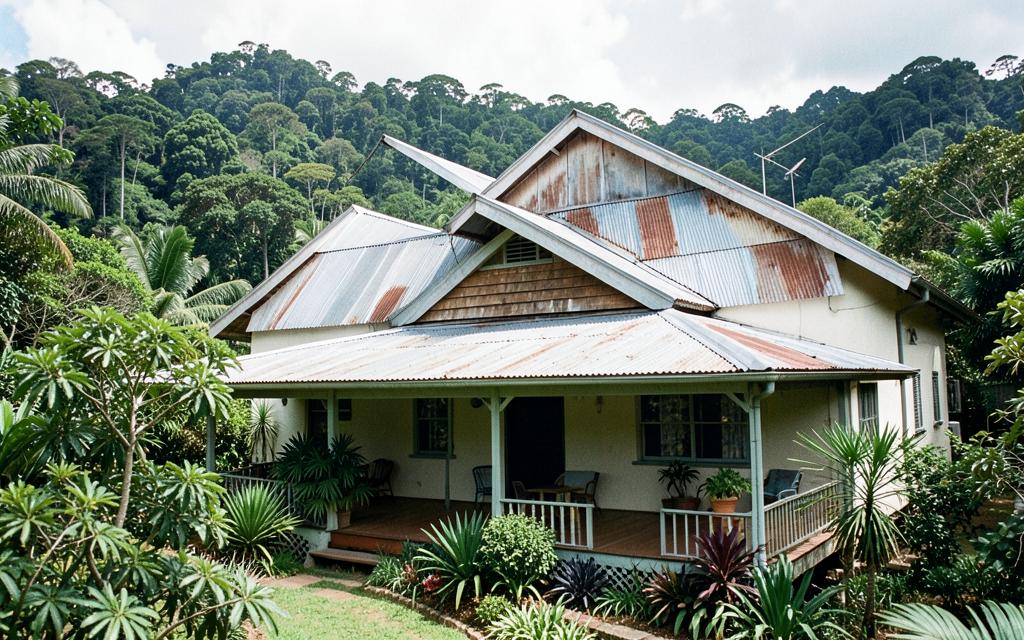
A great deal of the older Cairns housing stock is high-set timber with a steep corrugated roof, deep verandas and multiple roof planes meeting at hips and valleys. These roofs shed water beautifully when they are right, and they leak in very specific places when they are not.
Where Queenslander roofs typically leak
- Valleys where two steep planes meet, especially where a veranda roof joins the main roof.
- Veranda and lean-to junctions with lower-pitch sections and shallow flashings.
- Old fixings driven through the crown of the corrugation, where seals perish over decades.
- Chimney, vent and aerial penetrations added long after the roof was built.
- Gutter lines that discharge onto lower roof sections instead of into a downpipe.
Profile matching on older sheeting
Older corrugated profiles are not always identical to what is manufactured today, and mixing a slightly different pitch of corrugation into a run is how you create a permanent capillary path. We match profile where we can and re-sheet a full run rather than force a mismatch where we cannot.
Access and safety on high-set homes
Height, steep pitch and old timber under the roof all change how the work is staged. High-set homes need the right access equipment to inspect and repair safely, including over stairs and veranda edges — and areas of a roof that cannot be reached safely are areas that do not get properly assessed, which is how leaks get misdiagnosed.
Ventilation and the roof space
Many of these homes have minimal roof-space ventilation, and in Cairns humidity that shows up as condensation staining that looks exactly like a leak. Distinguishing condensation from water entry before quoting saves you paying for a repair that was never going to change anything.
Why old tin behaves differently
Corrugated iron on an older Queenslander was often laid in shorter sheets with generous overlaps, then fixed with lead-head nails or early screws. Decades later, each lap is a place for fine dust and moisture to collect. The sheet can look solid from the street while the lap above the gutter has thinned badly. That is why a proper check lifts its eye from the overall colour of the roof and looks closely at laps, nail holes and the bottom edge of each sheet.
Nail fixings are a particular issue. Timber battens move with humidity, nails slowly work loose, and the hole around each one gets larger. Replacing them with screws of the right gauge and length, into sound timber, often stops a leak that has been patched with sealant for years.
Verandas: the part of the roof most often forgotten
Many Queenslanders have a separate veranda roof at a lower pitch than the main roof. Where the two meet, water from a large roof area is pushed onto a shallow one, and old flashings can be overrun in a monsoon burst. Enclosed verandas add another complication, because a room now sits under a roof that was only ever meant to cover an open deck.
- Check the junction where the veranda roof meets the main wall.
- Look for ceiling boards that have cupped or stained along one line.
- Check the fall on low-pitch sections, as old timber can sag and hold water.
- Make sure gutters on the veranda are not taking the full run-off from the main roof.
Keeping the character of the house
Owners of older homes usually want the street view to stay the same, and that is reasonable. Replacement sheets can be chosen to match the original corrugation, and ridge capping and gutter profiles can be selected to suit the period of the home. If the property has a heritage listing or sits in a character area, check with Cairns Regional Council before changing the roof material or colour.
Repairs that are worth doing in order
With a limited budget, work in the order that protects the house. Start with anything letting water in, then fixings and flashings, then gutters and drainage. Cosmetic work such as coating comes last, once the roof beneath it is sound. An old roof that is repaired in this order will often give good service for years, and you will have photographs of what was done for the next owner or your insurer.
Older homes can also have hidden materials in eaves and linings, so ask about these before any cutting or drilling. If asbestos may be present, it needs to be identified and handled by people qualified to do it.